
Market Review – April 2026

Key Themes:
- Australian and international equities rose: Equity investors swiftly recovered from last month’s shock, using the opportunity to buy popular tech stocks at a discount.
- Australian and international bond prices rose slightly: Uncertainty around how long the price of oil would remain elevated and its ultimate impact on inflation created volatility in the bond market.
- Australian dollar appreciated: Rebounding from its losses in March as investors left the US dollar in favour of an Australian dollar supported by elevated commodity prices.
- Both oil and gold rose: The price of oil continued to be upheld by the close of the Strait of Hormuz while gold was supported by general market uncertainty and rising inflation expectations.
How the different asset classes have fared
(As at 3oth April)
International Equities
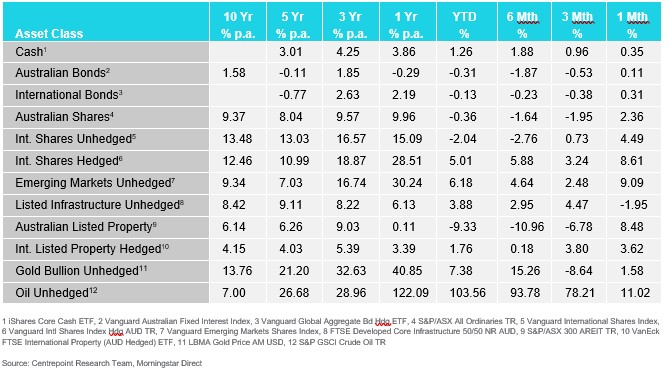
International equities rebounded in April, with unhedged returns rising by 4.49% and hedged returns rising by 8.61%, meaning the market regained what it lost in March and more. Hedged returns outperformed unhedged returns thanks to the Australian dollar also rebounding and appreciating against the US dollar over the month. Investors overlooked the geopolitical shock of the conflict between the US and Iran and the resulting rise in oil prices, using the sell-off triggered by this conflict to buy popular technology and AI stocks at a discount. This resurgence of risk-on sentiment was primarily driven by news of a ceasefire and diplomatic negotiations, and when these efforts stalled later in the month the market had already moved on.
From a regional perspective, US equities benefited the most from the rebound thanks to its large exposure to technology stocks and a strong reporting season within which 84% of companies in the S&P 500 reported that they beat profit expectations. Also contributing from a US perspective was the US’s relative insulation from oil supply risks, given strong domestic oil production. European equities lagged the US due to a greater dependence on imported energy, causing them to be more vulnerable to elevated energy prices. UK equities ended the month almost even with how they started as their high exposure to energy companies, which struggled over April, combined with low exposure to technology stocks limited their participation in the recovery.
Emerging market equities grew by 9.09%, rebounding strongly after being hit the hardest in March as investors rushed back into the region’s popular tech stocks which were available at a discount.
Australian Equities
Australian equities grew by 2.36% in April, almost recovering their losses from March before retreating slightly in the back half of the month. As in international markets the month started off well on news of negotiations in the Middle East. The Technology sector within Australia also benefited from the global tech rally although its small size within the index led to a limited impact on overall market returns. In the second half of the month elevated oil prices reignited inflation concerns, increasing expectations of further cash rate tightening by the Reserve Bank of Australia (RBA) which in turn weighed on equity valuations.
Other than the Technology sector Real Estate was the next-best-performing asset class, growing by 7.57%. The sector saw inflows following a period of sustained underperformance; this rotation was sparked by the US-Iran ceasefire announcement early in the month and the resulting expectation that the impact of oil prices on inflation would be less than previously expected. As the month continued and the Strait of Hormuz remained closed, these expectations reversed and the sector retracted slightly. Healthcare was the worst-performing sector for the month, falling by 10.06% as the largest company in the sector, CSL, fell by 12.52% to its lowest price since 2018. CSL suffered from the continued impact of a poor earnings report in February as concerns grew around the shrinking margins of its plasma business and demand for its vaccines in the US.
Domestic and International Fixed Income
In April Australian bonds returned just 0.11% as yields were whipsawed by constantly changing news coming out of the Middle East and the US. 10-year government bond yields floated between 4.90% and 5.00% for most of the month as the market remained uncertain of how long the Strait of Hormuz would remain closed and disrupt oil trade. As it became clear that the closure would continue for some time yields started to rise, ending the month at 5.08%.
International bonds had a similar experience, albeit to a slightly more extreme degree, growing by 0.31% over the month. Yields started the month in decline as a US-Iran ceasefire announcement increased hopes the elevated price of oil would start to fall; these hopes were dashed later in the month as the Strait of Hormuz remained closed. On 17 April, CPI data was released in the US, surprising to the upside as headline CPI rose by 0.90% over the month. This data was the catalyst for yields to start rising again, with the 10-year US government bond yield reaching 4.39% by the end of the month.
Despite bond yields rising both in Australia and internationally, bond returns were still positive thanks to the income being generated by these bonds offsetting the fall in price that results from the rising yields.
Australian Dollar
The Australian dollar appreciated by 4.05% against the US dollar in April. Most of this rise was a reverse of the safe-haven trade into the US dollar that occurred in March as investors fled uncertainty in the face of the US-Iran conflict. Also supporting the Australian dollar were expectations of further rate hikes in 2026 and elevated commodity prices.
Commodities – Gold and Oil
Oil prices continued to rise in April, growing by 11.02% as the disruption caused by the Strait of Hormuz continued. Prices retracted slightly in the middle of the month as the ceasefire announcement momentarily raised hopes of an end to the disruption, but when this failed to come to fruition prices rose back up above US$100 a barrel.
The price of gold rose by 1.58% in April, finally benefiting slightly from its safe-haven reputation following a price correction in March. Also contributing to gold’s performance was its inflation-hedge characteristics as the elevated price of oil fed into inflation expectations in many major economies.
Disclaimer
The information provided in this communication has been issued by Centrepoint Alliance Ltd and Ventura Investment Management Limited (AFSL 253045).
The information provided is general advice only has not taken into account your financial circumstances, needs or objectives. This publication should be viewed as an additional resource, not as your sole source of information. Where you are considering the acquisition, or possible acquisition, of a particular financial product, you should obtain a Product Disclosure for the relevant product before you make any decision to invest. Past performance does not necessarily indicate a financial product’s future performance. It is imperative that you seek advice from a registered professional financial adviser before making any investment decisions.
Whilst all care has been taken in the preparation of this material, no warranty is given in respect of the information provided and accordingly neither Centrepoint Alliance Ltd nor its related entities, guarantee the data or content contained herein to be accurate, complete or timely nor will they have any liability for its use or distribution.