
Market Review – June 2026
Key Themes:
- Shares were mixed, but a weaker Australian dollar lifted overseas returns: International equity markets were choppy as investors began to question whether the enthusiasm for technology and artificial intelligence (AI) companies had run too far. Australian equities were largely flat as investors rotated out of crowded sectors and into sectors that have been neglected so far in 2026.
- Bonds rose as the RBA paused: The Reserve Bank of Australia (RBA) left the cash rate unchanged at 4.35% for the first time this year, and a falling oil price eased some concerns about inflation. Both Australian and international bonds delivered positive returns off the back of these events and generated income.
- Australian dollar depreciated: A stronger US dollar and a lower oil price saw the Australian dollar slip to its lowest level in around three months.
- Oil tumbled and gold slipped: Progress towards a ceasefire in the Middle East and the prospect of the Strait of Hormuz shipping route reopening pulled the oil price sharply lower. Gold eased as a rising US dollar and expectations of higher interest rates for longer reduced its appeal.
How the different asset classes have fared
(As at 30th June)
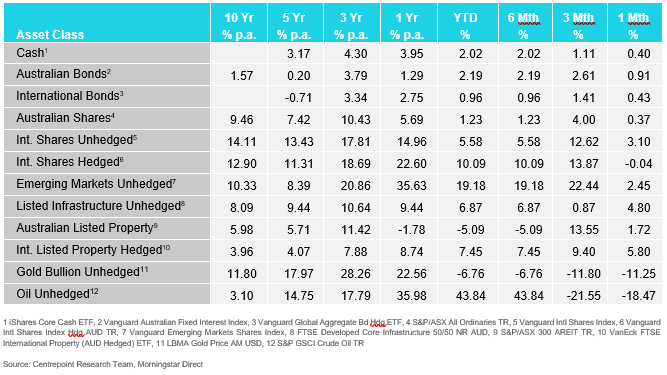
International Equities
The returns of international equities in June were largely dependent on whether the exposure was through a hedged vehicle or through an unhedged vehicle. Unhedged exposures returned 3.10%, while hedged exposures returned -0.04%. This difference arose due to the depreciation of the Australian dollar against the US dollar over the month.
The general mood in international markets was more cautious than in recent months. In the United States, the S&P 500 index retreated by 1.32% as investors started to worry that the powerful rally in technology and AI companies had become stretched. The technology sector specifically fell by 5.67%. More generally, the market saw a rotation out of growth sectors and into more defensive value sectors, with the health care sector growing by 7.72% and the utilities sector growing by 5.66%.
Emerging markets continued to perform well, rising 2.45%. These gains were again led by South Korea and Taiwan, home to many of the world’s most important semiconductor and AI hardware manufacturers, which continue to benefit from the global build-out of artificial intelligence.
Australian Equities
Australian shares rose a modest 0.37%. Unlike the United States or parts of Asia, the Australian share market has very few large technology or semiconductor companies. As a result, it was less impacted by declining fervour around these companies.
Overall sentiment in the market was still dampened by the changes to CGT on shares announced in May’s Federal Budget. The weakest sector was energy, falling by 9.20% as the price of oil continued to fall from its peak near the start of the US-Iran conflict. The materials sector also fell, retreating by 7.19% as commodity prices declined and investors decided to leave the crowded resources trade. The health care sector was the main beneficiary of the rotation out of energy and materials, rising by 15.19% from a nine-year low at the start of the month as investors sought to find value in the market.
Domestic and International Fixed Income
Australian bonds returned 0.91% in June. The main event of the month was the RBA’s decision to leave the cash rate unchanged at 4.35%, its first pause after three increases earlier in the year. The RBA noted that its earlier rate rises were starting to slow the economy as intended, while being careful to say that inflation remained too high and that it had not ruled out further increases. Bond prices tend to rise when investors believe interest rates are at or near their peak, and with the cash rate on hold and the oil price falling, concerns about inflation eased a little. This supported bond prices and produced a positive return.
International bonds returned 0.43%. The sharp fall in the oil price through the month reduced some of the worry about global inflation, which allowed bond yields to ease and slightly helped returns. Also contributing to returns was the income being generated by bonds at their current yield levels. Working against bonds was the generally more nervous mood in share markets late in the month, although this had only a modest effect.
Australian Dollar
The Australian dollar depreciated against the US dollar over June, easing from around US$0.72 at the start of the month to roughly US$0.69 by month-end, its lowest level in about three months. This movement was due to both a strengthening in the US dollar and a weakening in the Australian dollar. The US dollar was supported by a more hawkish Federal Reserve, while the Australian dollar weakened due to softening oil and commodity prices.
Commodities – Gold and Oil
Oil continued its fall in June, declining by 18.47%. Growing confidence that the conflict in the Middle East was heading towards a ceasefire, together with the prospect of the Strait of Hormuz reopening, unwound much of the price premium that the conflict had built into oil. By the end of the month, the oil price had fallen back towards where it sat before the conflict began.
The price of gold slipped by 11.25%. The main pressures on the precious metal were a stronger US dollar and expectations that interest rates would remain higher for longer, both of which reduce the appeal of gold because it pays no income. Fading demand for safe-haven assets, as the prospect of a ceasefire grew, added to the decline.
Disclaimer
The information provided in this communication has been issued by Centrepoint Alliance Ltd and Ventura Investment Management Limited (AFSL 253045).
The information provided is general advice only has not taken into account your financial circumstances, needs or objectives. This publication should be viewed as an additional resource, not as your sole source of information. Where you are considering the acquisition, or possible acquisition, of a particular financial product, you should obtain a Product Disclosure for the relevant product before you make any decision to invest. Past performance does not necessarily indicate a financial product’s future performance. It is imperative that you seek advice from a registered professional financial adviser before making any investment decisions.
Whilst all care has been taken in the preparation of this material, no warranty is given in respect of the information provided and accordingly neither Centrepoint Alliance Ltd nor its related entities, guarantee the data or content contained herein to be accurate, complete or timely nor will they have any liability for its use or distribution.