
Market Review – August 2026
Key Themes:
-
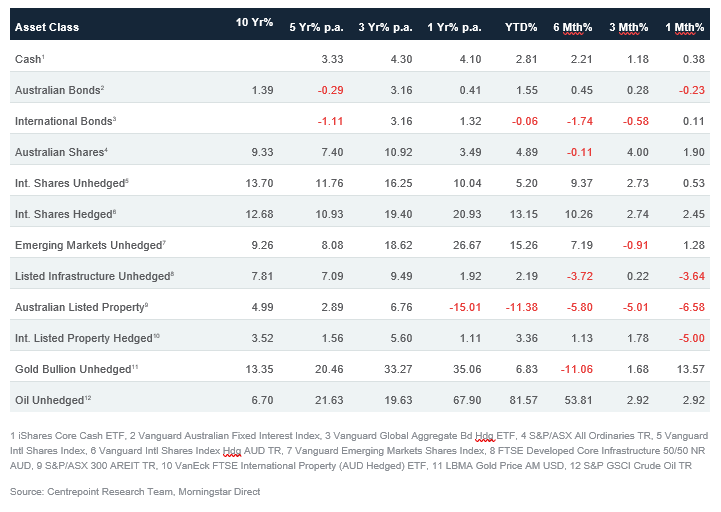
Australian shares rose again, but reporting season split the market: Australian shares gained 1.90%, a fifth consecutive monthly rise. Healthcare was the best performing sector and mining companies reached record highs, while banks, retailers and listed property trusts were sold down.
-
Global share markets recovered: Technology and semiconductor shares regained most of the ground they lost in July as company results showed that spending on artificial intelligence was translating into revenue.
-
Bonds were flat and interest rate sensitive assets fell: The Reserve Bank left the cash rate at 4.35%, but underlying inflation held at 3.60%, and long-term interest rates stayed near multi-year highs. Australian bonds returned -0.23% and international bonds 0.11%.
-
Gold had its strongest month in decades: Gold returned 13.57% as weak US employment data, a US Treasury plan to buy back long-dated bonds, and continued central bank buying lifted the price from near US$4,000 an ounce to above US$4,700 at one point. Oil was comparatively calm, rising 2.92%.
How the different asset classes have fared
(As at 31st August)
International Equities
International shares rose 0.53% on an unhedged basis and 2.45% on a hedged basis. The Australian dollar rose against the US dollar over August, so investors who had removed the currency effect through hedging kept more of the gains in the month.
Markets recovered well from July’s sell-off. Technology and semiconductor shares regained momentum as a strong company reporting season showed that the heavy spending on artificial intelligence was being matched by growing demand for cloud services. In the United States the S&P 500 reached a record high early in the month and finished August 2.62% higher, while the technology-heavy Nasdaq gained 4.18%. Mining and energy companies were among the strongest sectors globally as commodity prices climbed, and European markets also finished higher on solid company profits.
Emerging markets rose 1.28%, or closer to 3% for a hedged exposure, as the Korean and Taiwanese semiconductor companies that dominate the index recovered much of what they lost in July.
Australian Equities
Australian shares rose 1.90%, a fifth consecutive monthly gain and well ahead of the 0.53% return from unhedged international shares. August is full-year reporting season in Australia, and the results produced unusually wide differences between sectors.
Healthcare was the standout, rising about 18.74% over the month, with CSL gaining more than 20% in a single week after its full-year result. Mining companies also did well, with the materials sector rising 12.04% and reaching record highs as gold and copper prices climbed. Smaller companies outperformed the largest, helped by gold miners. On the downside, consumer discretionary companies fell almost 8% and the major banks gave back more than 5% after a long run of gains.
Australian listed property fell 6.58% and remains the weakest asset class in the table over the past year at -15.01% as higher long-term interest rates reduced the attractiveness of the asset class.
Domestic and International Fixed Income
Australian bonds returned -0.23% in August. The Reserve Bank of Australia (RBA) held the cash rate at 4.35% at its meeting on the 11th of August, its second consecutive pause after three increases earlier in 2026, and repeated that inflation was still too high and that further increases were possible. The monthly inflation figures released on the 26th of August showed headline inflation easing to 3.50% over the year, down from 3.80% in June, but the RBA’s preferred trimmed mean measure held steady at 3.60%, and prices rose 1.00% in the month itself, more than economists had expected. Investors responded by increasing the chance of another rate rise, and the yield on the 10-year Australian government bond rose to around 5.09% by month-end, its highest level in more than a decade. Bond prices move in the opposite direction to yields, so this produced a small negative return that offset the income the bonds paid.
International bonds returned 0.11%, but the flat result hides an eventful month. Long-term US government bond yields reached their highest level in about 19 years in the middle of August, which prompted the US Treasury to announce that it would step up its buybacks of long-dated bonds in an effort to bring those yields back down. That largely worked, and long-term yields steadied. Then on the 28th of August the new chairman of the US Federal Reserve, Kevin Warsh, told the Jackson Hole symposium that the central bank still had work to do on inflation. Short-term yields jumped, with the two-year bond yield rising to about 4.31%, while the 10-year and 30-year yields barely moved, and markets ended the month pricing a better than even chance of a US rate rise in September.
Australian Dollar
The Australian dollar rose against the US dollar over August, moving from around US$0.70 at the start of the month to about US$0.72 at month-end, a gain of roughly 2%.
Three forces were behind the move. Commodity prices were firm, with gold and copper both strong and the oil price holding above US$90 for most of the month, which supports Australia’s export earnings. Inflation at home stayed high enough that investors could not rule out another RBA rate rise, and higher relative interest rates tend to attract money into a currency. The US dollar was also generally soft through much of August after weak US employment figures raised doubts about the strength of that economy. The Australian dollar reached its highest level of the month in the final week before easing slightly once the US Federal Reserve chairman signalled that US rates might need to rise.
Commodities – Gold and Oil
Gold was the standout of the month, returning 13.57%. It entered August near US$4,000 an ounce after its worst quarter since 2013, then rallied almost without pause. Weak US employment figures and softer inflation data early in the month reduced the perceived chance of a US rate rise, increasing the relative attractiveness of gold. Gold traded above US$4,700 an ounce in the final week before easing once the US Federal Reserve chairman signalled that rates could rise. In US dollar terms the gain was around 14%, gold’s strongest month in many years.
|
Disclaimer The information provided in this communication has been issued by Centrepoint Alliance Limited ABN 72 052 507 507 and Ventura Investment Management Ltd ABN 49 092 375 258 (AFSL 253045). The information provided is general advice only and has not taken into account your individual financial situation, needs or objectives. This publication should be viewed as an additional resource, not as your sole source of information. You should consider the Product Disclosure Document for a particular product before deciding to acquire or continue to hold a product. Past performance is not necessarily indicative of future performance. It is imperative that you seek advice from a registered professional financial adviser before making any investment decisions. Whilst all care has been taken in the preparation of this material, no warranty is given in respect of the information provided and accordingly neither Centrepoint Alliance Limited nor its related entities guarantee the data or content contained herein to be accurate, complete or timely nor will they have any liability for its use or distribution. |
Oil rose 2.92%, a far quieter month than June or July. Brent crude, the main international benchmark, began August around US$90 a barrel and climbed above US$95 mid-month as shipping through the Strait of Hormuz stayed well below normal. It then fell more than 7% in two sessions in the final week, closing near US$87 on the 25th of August, after new US sanctions on Iran proved milder than expected and a diplomatic initiative raised hopes of a settlement. Prices recovered to around US$93 by month-end.
Disclaimer
The information provided in this communication has been issued by Centrepoint Alliance Ltd and Ventura Investment Management Limited (AFSL 253045).
The information provided is general advice only has not taken into account your financial circumstances, needs or objectives. This publication should be viewed as an additional resource, not as your sole source of information. Where you are considering the acquisition, or possible acquisition, of a particular financial product, you should obtain a Product Disclosure for the relevant product before you make any decision to invest. Past performance does not necessarily indicate a financial product’s future performance. It is imperative that you seek advice from a registered professional financial adviser before making any investment decisions.
Whilst all care has been taken in the preparation of this material, no warranty is given in respect of the information provided and accordingly neither Centrepoint Alliance Ltd nor its related entities, guarantee the data or content contained herein to be accurate, complete or timely nor will they have any liability for its use or distribution.