
Market Review – May 2026
Key Themes:
- Shares rose strongly, led by overseas markets: Investors grew more confident that the conflict between the US and Iran was heading towards a ceasefire. Together with renewed enthusiasm for technology and AI companies, this lifted global share markets, with emerging markets and the US leading the way. Australian shares posted a smaller gain.
- Bond prices rose even as interest rates went up: The Reserve Bank of Australia raised the cash rate to 4.35%, yet both Australian and international bonds still delivered positive returns, as investors judged that interest rates were close to their peak and a falling oil price calmed worries about inflation.
- Australian dollar appreciated: Supported by high commodity prices and the RBA’s higher interest rates, the Australian dollar appreciated against the US dollar and touched its highest level for 2026 in the middle of the month.
- Oil fell sharply and gold slipped: Hopes of a ceasefire, and of the Strait of Hormuz eventually reopening, unwound much of the price premium that the war had built into oil. Gold eased a little as demand for safe-haven assets faded and interest rates stayed high.
How the different asset classes have fared
(As at 31st May)
International Equities
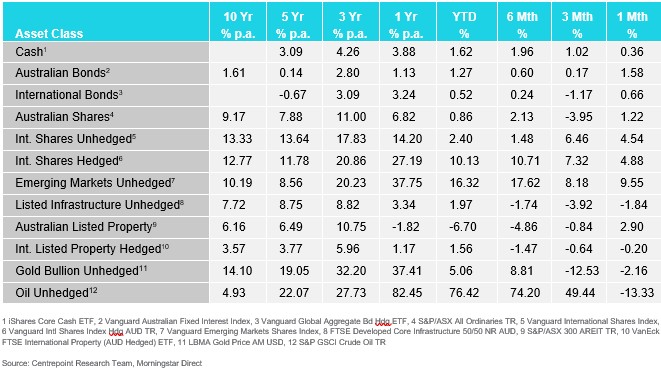
International equities had a very strong month in May. Unhedged returns rose by 4.54% while hedged returns rose by 4.88%. Unhedged and hedged exposures experienced similar returns this month because the Australian dollar moved only modestly against the US dollar.
The rally in international equities had two main drivers: growing optimism that the US and Iran were moving towards a ceasefire, and a powerful comeback in technology and AI companies. In the US, the S&P 500 index climbed around 5% to a record high, its best May in roughly three decades, even though the majority of sectors actually fell over the month. The gains were heavily concentrated in a small number of large technology names, with computer maker Dell and chipmaker Micron among the standouts on the back of strong demand for AI-related hardware. The worst performing sectors were Energy, as the price of oil retreated on hopes of de-escalation between the US and Iran, and notable value sectors such as Healthcare and Consumer Staples as investors rotated back into growth names.
Emerging markets were the standout region, surging 9.55%. The gains were led by South Korea and Taiwan, home to many of the world’s most important semiconductor and AI-hardware manufacturers, which are benefiting directly from the global build-out of AI.
Australian Equities
Australian shares rose a more modest 1.22%, with several forces pulling in different directions. On the positive side, the global technology rally and a fall in local interest rates on bonds supported the market and were particularly helpful for interest-rate-sensitive sectors, such as Australian listed property which rose by 2.97%. The Materials sector rose by 8.21% as mining companies, helped by strong commodity prices, provided support and cushioned the market.
Pulling the other way was the announcement of the Federal Budget on the 12th of May. The proposed budget included some of the most significant changes to investment taxation in over two decades, including replacing the long-standing 50% capital gains tax discount with a different method from mid-2027 and tightening the rules around negative gearing. These proposals unsettled investors. The major banks fell, with Commonwealth Bank dropping by over 10% in a single session after it reported softer profits and set aside more money for bad loans. The Healthcare sector was weak too, falling by 9.38%, as CSL fell on a further profit downgrade.
Domestic and International Fixed Income
Australian bonds returned 1.58% in May. The biggest event of the month was the Reserve Bank of Australia’s (RBA) decision to lift the cash rate by 0.25% to 4.35%, its third increase for 2026, as it continues to battle inflation that has been pushed higher by surging fuel prices. An increase in the cash rate would normally be associated with a fall in bond prices, but prices rose this month despite the rate hike as investors believed that the RBA was close to finishing its rate rises. This belief came as the RBA signalled that it now had room to pause and was further reinforced when softer inflation and unemployment figures released later in the month. As a result, the yield on the 10-year Australian government bond drifted down from around 5.00% to about 4.80%, lifting bond prices and producing a positive return.
International bonds returned 0.66%, as the retreat in oil prices throughout the month eased some of the worry about global inflation and allowed bond yields to ease. Somewhat hurting bond returns though was the general risk-on sentiment in the market as investors sought to participate in the strong rise of technology companies rather than invest in safer bond assets.
Australian Dollar
The Australian dollar appreciated against the US dollar over May, reaching its highest level for 2026 of around US$0.726 in the middle of the month before easing back to roughly US$0.72 by month-end. The Australian dollar was supported by the RBA’s cash rate hike as well as high commodity prices throughout the month.
Commodities – Gold and Oil
Oil was the biggest mover of the month, falling by 13.33%. Growing confidence that the US and Iran were progressing towards a ceasefire and the potential reopening of the Strait of Hormuz released some of the upward pressure on the price of oil.
Gold slipped 2.16%. Despite continuing geopolitical tension, it eased over the month as the prospect of a ceasefire reduced safe-haven demand. Also dragging down the price of gold was interest rates staying elevated, making a non-income paying asset such as gold less attractive.
Disclaimer
The information provided in this communication has been issued by Centrepoint Alliance Ltd and Ventura Investment Management Limited (AFSL 253045).
The information provided is general advice only has not taken into account your financial circumstances, needs or objectives. This publication should be viewed as an additional resource, not as your sole source of information. Where you are considering the acquisition, or possible acquisition, of a particular financial product, you should obtain a Product Disclosure for the relevant product before you make any decision to invest. Past performance does not necessarily indicate a financial product’s future performance. It is imperative that you seek advice from a registered professional financial adviser before making any investment decisions.
Whilst all care has been taken in the preparation of this material, no warranty is given in respect of the information provided and accordingly neither Centrepoint Alliance Ltd nor its related entities, guarantee the data or content contained herein to be accurate, complete or timely nor will they have any liability for its use or distribution.