
Market Review – October 2026
Key Themes:
-
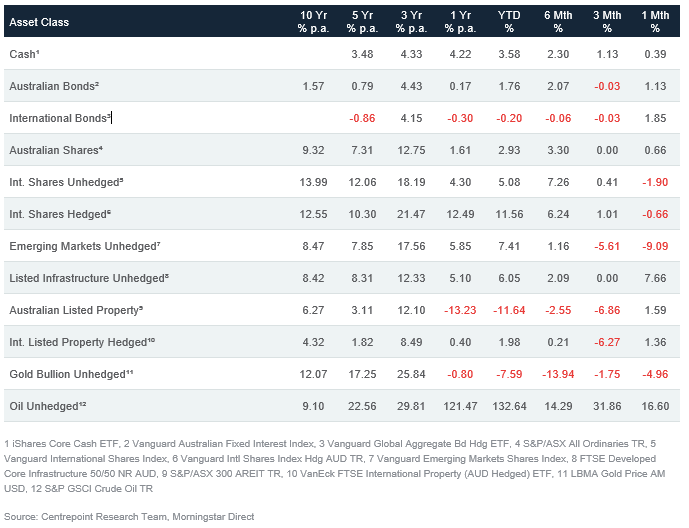
A sell-off in technology shares pulled global markets lower, but many other companies rose: Investors began to question the very large sums being spent on artificial intelligence (AI), and the biggest technology companies fell sharply. Emerging markets, which hold many of the world’s computer chip makers, fell 9.09%. Away from technology, many companies in more defensive areas such as energy, healthcare, utilities and everyday consumer goods performed well, and listed infrastructure rose 7.66%.
-
Bonds rose as interest rates on government bonds fell back from multi-year highs: As investors moved money out of technology shares and into safer assets, bond yields fell and bond prices rose. Australian bonds returned 1.13% and international bonds returned 1.85%. The US Federal Reserve left interest rates unchanged, and the Reserve Bank of Australia (RBA) did not meet during the month.
-
Australian shares edged higher and the Australian dollar rose: Australian shares gained 0.66%, helped by a strong month for the big banks. The Australian dollar rose against the US dollar, particularly after higher-than-expected inflation figures late in the month increased expectations of another RBA rate rise. This reduced returns from unhedged overseas investments.
-
Oil rose sharply and gold fell: Attacks on oil tankers in the Strait of Hormuz and fears of renewed conflict involving Iran pushed oil up 16.60%. Gold fell 4.96% and finished the month at its lowest level of 2026 in US dollar terms.
How the different asset classes have fared
(As at 31st October)
International Equities
International shares fell in October, with unhedged returns down 1.90% and hedged returns down 0.66%. This month the hedged return was the better of the two. The gap came from the Australian dollar, which rose against the US dollar over the month. When the Australian dollar rises, overseas investments are worth less once they are converted back into Australian dollars, which added to the loss for unhedged investors. Hedged returns remove this currency effect and are closer to how the underlying share markets performed, which was a small decline.
The headline numbers hid very large differences beneath the surface. Investors started asking harder questions about the huge amounts being spent to build AI, shifting attention from what AI might earn to what it costs. Alphabet, the parent company of Google, had its worst day since listing after reporting that it had spent more cash than it brought in. In the United States, the S&P 500 index fell around 1% and the technology-heavy Nasdaq fell more than 5%, yet the equal-weight S&P 500 index rose around 5%. Energy, consumer staples and healthcare companies rose strongly, while European shares had their best month since June. Listed infrastructure, which includes utilities and other essential-service businesses that investors tend to favour in uncertain times, rose 7.66%.
Emerging markets fell 9.09%, the weakest result in the table. The emerging markets index has a large weighting to computer chip makers in South Korea and Taiwan, and both markets fell sharply as the technology sell-off spread to companies that make chips and equipment for AI. Brazilian shares also fell heavily after an unexpected presidential election result late in the month.
Australian Equities
Australian shares rose 0.66%, outperforming international share markets. Because the Australian market has relatively few large technology companies, it was much less exposed to the AI sell-off that hurt markets overseas. The month began badly, with the ASX 200 index falling around 2% on the first day of October as bond yields stayed high following the RBA’s rate rise at the end of September, but the market recovered steadily from there.
The big banks were the main support, with the banking sector rising around 8% over the month. Utilities were the best-performing sector, rising more than 9% as investors favoured defensive businesses. Mining companies were mixed, and smaller companies generally fell, which held back the broader market. Late in the month, September quarter inflation figures came in higher than expected and moved further above the RBA’s 2–3% target, which increased expectations of another rate rise at the RBA’s November meeting. Australian listed property rose 1.59%, helped by lower bond yields, although it remains down 11.64% for the year to date.
Domestic and International Fixed Income
Australian bonds returned 1.13% in October. The RBA did not meet during the month and the cash rate stayed at 4.60% following its increase in late September. Australian 10-year government bond yields started October at around 5.40%, their highest level in about 15 years, and fell to around 5.10% by month-end. Bond prices move in the opposite direction to yields, so this fall in yields produced a positive return. Yields eased as global bond markets rallied, as a softer-than-expected jobs report reduced pressure for further rate rises, and as investors sought safer assets during the technology sell-off. The higher-than-expected inflation figures late in the month lifted yields again for a few days, but not by enough to reverse the earlier gains.
International bonds returned 1.85%. The US Federal Reserve left interest rates unchanged at 3.75% to 4.00% on the 28th of October, although two of its twelve voting members pushed for a further increase. US 10-year government bond yields fell from close to 5.30% at the start of the month to around 5.00% by the end, as investors moved money out of shares and into high-quality government bonds.
Australian Dollar
The Australian dollar rose slightly against the US dollar over October, from around US$0.70 at the start of the month to very slightly above US$0.70 by month-end. It dipped towards US$0.69 in the middle of the month before recovering.
The main force was the outlook for Australian interest rates. Higher-than-expected September quarter inflation figures on the 28th of October led investors to sharply increase their expectations of another RBA rate rise in early November, and the Australian dollar reached a five-week high. By contrast, the US Federal Reserve kept interest rates on hold, and lower US bond yields reduced some of the appeal of the US dollar.
Commodities – Gold and Oil
Oil rose 16.60%, its fourth monthly gain in a row. Attacks on oil tankers in the Strait of Hormuz, attacks on Saudi Arabian oil facilities by Iran-aligned groups in Yemen, and fears that the conflict involving Iran could escalate after the US midterm elections all raised concerns about energy supplies. Brent crude, the global benchmark, rose to finish the month near US$118 a barrel, its highest level since April.
Gold fell 4.96%, its second monthly fall in a row, and it is now down 7.59% for the year to date. In US dollar terms, gold finished the month below US$3,900 an ounce, its lowest level of 2026 and around 30% below its January record. Most of the decline came in the second half of October, including a sharp fall on the final trading day. Stronger US economic data and inflation kept expectations of further US rate rises alive, which reduces the appeal of gold because it pays no income, and some investors sold gold to cover losses elsewhere during the technology sell-off.
|
Disclaimer The information provided in this communication has been issued by Centrepoint Alliance Limited ABN 72 052 507 507 and Ventura Investment Management Ltd ABN 49 092 375 258 (AFSL 253045). The information provided is general advice only and has not taken into account your individual financial situation, needs or objectives. This publication should be viewed as an additional resource, not as your sole source of information. You should consider the Product Disclosure Document for a particular product before deciding to acquire or continue to hold a product. Past performance is not necessarily indicative of future performance. It is imperative that you seek advice from a registered professional financial adviser before making any investment decisions. Whilst all care has been taken in the preparation of this material, no warranty is given in respect of the information provided and accordingly neither Centrepoint Alliance Limited nor its related entities guarantee the data or content contained herein to be accurate, complete or timely nor will they have any liability for its use or distribution. |
Oil rose 2.92%, a far quieter month than June or July. Brent crude, the main international benchmark, began August around US$90 a barrel and climbed above US$95 mid-month as shipping through the Strait of Hormuz stayed well below normal. It then fell more than 7% in two sessions in the final week, closing near US$87 on the 25th of August, after new US sanctions on Iran proved milder than expected and a diplomatic initiative raised hopes of a settlement. Prices recovered to around US$93 by month-end.
Disclaimer
The information provided in this communication has been issued by Centrepoint Alliance Ltd and Ventura Investment Management Limited (AFSL 253045).
The information provided is general advice only has not taken into account your financial circumstances, needs or objectives. This publication should be viewed as an additional resource, not as your sole source of information. Where you are considering the acquisition, or possible acquisition, of a particular financial product, you should obtain a Product Disclosure for the relevant product before you make any decision to invest. Past performance does not necessarily indicate a financial product’s future performance. It is imperative that you seek advice from a registered professional financial adviser before making any investment decisions.
Whilst all care has been taken in the preparation of this material, no warranty is given in respect of the information provided and accordingly neither Centrepoint Alliance Ltd nor its related entities, guarantee the data or content contained herein to be accurate, complete or timely nor will they have any liability for its use or distribution.