
Market Review – September 2026
Key Themes:
-
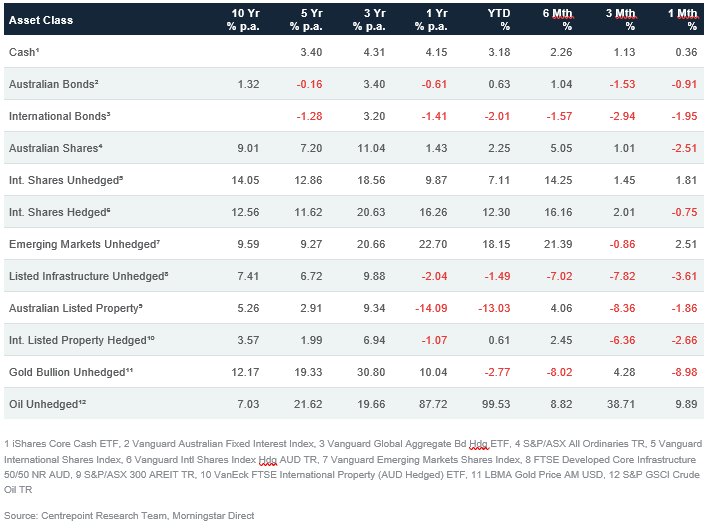
Interest rates rose in both the United States and Australia, and shares fell back: The US Federal Reserve raised interest rates for the first time since 2023, and the Reserve Bank of Australia (RBA) lifted the cash rate to 4.60%, its fourth increase this year. Australian shares fell 2.51% and hedged international shares fell 0.75%.
-
Bonds fell as interest rates on government bonds climbed: Both Australian bonds (down 0.91%) and international bonds (down 1.95%) lost value as bond yields rose around the world. Bond prices move in the opposite direction to yields.
-
A weaker Australian dollar cushioned overseas investments: The Australian dollar fell against the US dollar, so unhedged international shares rose 1.81% while hedged international shares fell 0.75%.
-
Gold fell sharply and oil rose: Gold fell 8.98% as higher interest rates reduced its appeal. Oil rose 9.89% as tension between the United States and Iran around the Strait of Hormuz kept energy supplies in question.
How the different asset classes have fared
(As at 30th September)
International Equities
International shares produced different results depending on whether the currency exposure was hedged or not. Unhedged returns rose 1.81% while hedged returns fell 0.75%. The gap came almost entirely from the Australian dollar, which fell against the US dollar over September. When the Australian dollar falls, overseas investments are worth more once they are converted back into Australian dollars, which lifted the return for unhedged investors. Hedged returns remove the currency effect and are closer to how the underlying share markets performed, which was a small decline.
In the United States, the S&P 500 index rose by 0.26%, the Dow Jones Industrial Average fell by just over 3.50%, while the technology-heavy Nasdaq rose by 2.91%. The Federal Reserve raised its interest rate by 0.25 percentage points on the 16th of September, its first increase since 2023, and signalled that more increases may be needed to curb inflation. US long-term government bond yields rose to around 5.30%, their highest level in almost two decades. Higher yields make shares less attractive in the market compared to bonds and increase borrowing costs for companies, both hurting returns on shares; the market was also unsettled by higher oil prices. Technology companies were the bright spot, helping the Nasdaq to outperform other markets.
Emerging markets rose 2.51% in unhedged terms, outperforming the US, European and Australian markets. The emerging markets index has a very large weighting to semiconductor and AI hardware makers in South Korea and Taiwan, so it tends to move with the technology theme, which was also the strongest part of the US market in September.
Australian Equities
Australian shares fell 2.51%, lagging international share markets and marking the first monthly fall in around six months. The main ASX 200 index slid to its lowest level since June in the final full week of the month, before recovering a little in the last few trading days.
The main pressure was interest rates. Inflation in Australia has stayed above the Reserve Bank of Australia’s (RBA) target, and through the month investors increasingly expected another rate rise, which arrived late in September. Healthcare was the only sector to rise in the face of this pressure as CSL continued to strengthen off the back of an improving outlook for the company. The big banks and the major miners, including BHP and Rio Tinto, were weak on a number of trading days. Australian listed property fell 1.86%, and over the past year it is down 14.09%, as higher interest rates reduced the appeal of income-producing assets.
Domestic and International Fixed Income
Australian bonds returned -0.91% in September. On the 29th of September the RBA raised the cash rate by 0.25 percentage points to 4.60%, its fourth increase of 2026 and the highest level since 2011, with all nine members of the Board voting in favour. The decision was widely expected, but the RBA said inflation was still too high, that higher energy prices linked to the widening conflict in the Middle East were feeding into other prices, and that further increases remained possible if needed. When investors expect interest rates to stay higher for longer, bond yields rise. Bond prices move in the opposite direction to yields, because existing bonds paying lower interest become less valuable, so the higher yields produced a negative return.
International bonds returned -1.95%. The Federal Reserve’s rate increase pushed bond yields higher in the United States, and yields also rose in many other countries as investors grew more concerned about large government debts and deficits and asked for extra compensation to lend to governments over long periods.
Australian Dollar
The Australian dollar fell against the US dollar over September, easing from around US$0.72 at the start of the month to roughly US$0.70 by month-end. It held near US$0.72 in the first week or so, while investors priced in the RBA’s rate rise, then slipped through the second half of the month. The move matches the gap between unhedged and hedged international shares, which implied a fall of a little over 2.5%.
The main force was a stronger US dollar. The Federal Reserve’s rate increase, and its signal that more could follow, pushed US interest rates to multi-year highs and made US dollar assets more attractive. The RBA’s own increase to 4.60% was not enough to offset this.
Commodities – Gold and Oil
Gold fell 8.98%, its weakest month since June, and it is now down 2.77% for the year to date. Gold pays no income, so it tends to lose appeal when interest rates and bond yields rise, as they did in September following the Federal Reserve’s rate increase and the climb in yields around the world. A stronger US dollar, which makes gold more expensive for overseas buyers, added to the pressure.
Oil rose 9.89%. Renewed fighting between the United States and Iran, and uncertainty over shipping through the Strait of Hormuz, kept energy supplies in doubt. Brent crude, the global benchmark, rose around 14% in US dollars over the month to be a little above US$100 a barrel, while the US benchmark, known as WTI, rose by less.
|
Disclaimer The information provided in this communication has been issued by Centrepoint Alliance Limited ABN 72 052 507 507 and Ventura Investment Management Ltd ABN 49 092 375 258 (AFSL 253045). The information provided is general advice only and has not taken into account your individual financial situation, needs or objectives. This publication should be viewed as an additional resource, not as your sole source of information. You should consider the Product Disclosure Document for a particular product before deciding to acquire or continue to hold a product. Past performance is not necessarily indicative of future performance. It is imperative that you seek advice from a registered professional financial adviser before making any investment decisions. Whilst all care has been taken in the preparation of this material, no warranty is given in respect of the information provided and accordingly neither Centrepoint Alliance Limited nor its related entities guarantee the data or content contained herein to be accurate, complete or timely nor will they have any liability for its use or distribution. |
Oil rose 2.92%, a far quieter month than June or July. Brent crude, the main international benchmark, began August around US$90 a barrel and climbed above US$95 mid-month as shipping through the Strait of Hormuz stayed well below normal. It then fell more than 7% in two sessions in the final week, closing near US$87 on the 25th of August, after new US sanctions on Iran proved milder than expected and a diplomatic initiative raised hopes of a settlement. Prices recovered to around US$93 by month-end.
Disclaimer
The information provided in this communication has been issued by Centrepoint Alliance Ltd and Ventura Investment Management Limited (AFSL 253045).
The information provided is general advice only has not taken into account your financial circumstances, needs or objectives. This publication should be viewed as an additional resource, not as your sole source of information. Where you are considering the acquisition, or possible acquisition, of a particular financial product, you should obtain a Product Disclosure for the relevant product before you make any decision to invest. Past performance does not necessarily indicate a financial product’s future performance. It is imperative that you seek advice from a registered professional financial adviser before making any investment decisions.
Whilst all care has been taken in the preparation of this material, no warranty is given in respect of the information provided and accordingly neither Centrepoint Alliance Ltd nor its related entities, guarantee the data or content contained herein to be accurate, complete or timely nor will they have any liability for its use or distribution.